Your Child Is Afraid of Water: Preparing for the First Swimming Lesson in a Week
Is your child afraid of water? A one-week plan can gently prepare them for their first lesson, ease anxiety, and prevent overload.
· 8 min read · 7 sources

Photo: Porapak Apichodilok
If your child is afraid of water, the goal of the first week is not to teach them to swim, but to make water feel predictable and safe. Begin with short games at home, calm conversations, and a relaxed introduction to what the upcoming lesson will be like. For a preschooler, 5–10 minutes a day is enough; for a school-aged child, allow up to 15 minutes. Do not pressure your child or force them to put their face in the water.[1] [2] [3]
Scientific reviews suggest that swimming instruction should begin by building comfort in the aquatic environment and basic movement confidence, with technique introduced later. Even after several lessons, a young child will usually still need an adult’s help: lessons do not replace constant supervision around water or other safety measures.[1] [2] [4]

Photo: jason hu
30 min
approximate length of a trial lesson[2]
Understand the fear before trying to overcome it
Ask your child: “What exactly feels scary—the cold water, splashes, depth, an unfamiliar instructor, or having to put your face in?” The answer will determine the first step. If splashing is the problem, begin by pouring water from one cup into another. If depth is frightening, talk only about the shallow area and the option of holding on to the pool edge. This gradual approach reflects current thinking about developing water competence.[1] [2]
Do not promise that “there is nothing to be afraid of,” and do not compare your child with siblings or classmates. Instead, agree on a stop signal in advance: a raised hand means “pause.” For children aged 1–3, activities with a parent are especially important. At ages 4–6, you can add brief independent actions beside the instructor, while a school-aged child can be told exactly how the lesson will unfold.[2] [3] [7]
- 1.Name the feeling: “It looks like you’re feeling worried.”
- 2.Use a toy to show how it touches the water and comes back out.
- 3.Let your child choose a towel, goggles, or toy to bring to the lesson.
- 4.Explain in advance how long the lesson will last and that they can take a break.
- 5.After each small step, praise the effort rather than the result.
A one-week preparation plan: school, rest, and the pool
Here is an example for a 5–10-year-old who attends school and is trying swimming for the first time. If your child has a split school schedule, move the home practice to the morning or a day off. On a hot day, do not schedule the pool immediately after a long journey and active play. Leave time for water, a snack, and quiet recovery.[3] [7]
This schedule is not a medical standard; it is simply a guide to the rhythm of the week. Leave at least 60–90 minutes between school activities and the pool for food and rest. It is best to schedule the first lesson on a day without another demanding class, so your child arrives rested and can calmly take in the instructor’s directions.[2] [3]
| Day | After school | At-home step | Rest |
|---|---|---|---|
| Mon | School and a relaxed walk | 5 min of playing with water on the hands | 30–60 min without screens |
| Tue | School and homework | 10 min: blowing into a cup of water | Early bedtime |
| Wed | School without another class | 10 min: “wet hands, dry face” | Quiet play |
| Thu | School and a light walk | 15 min: talking about the pool and the pause signal | Pack the bag together |
| Fri | First lesson, 20–30 min | Simply revisit a pleasant moment | Calm evening |
| Sat | Free day | 5–10 min of play if your child wants to | Family walk |
A home warm-up and posture exercises
The warm-up is not meant to “train a swimmer.” It gently gets the body moving before play or the trip to the pool. Do it on a non-slip mat, without pain or breath-holding. For children aged 4–6, one round is enough; children aged 7–14 can do two if they are not tired.[5]
Posture exercises cannot correct lasting physical changes on their own and should never be done through pain. They help children change position more often and gently activate the muscles of the trunk and shoulder area. If your child complains of back pain, stiffness, or pain after a lesson, cancel the workout and discuss the situation with a specialist.[5] [6]
- 1.“Cat” on all fours: slowly round and straighten the back 6–8 times.
- 2.“Wall”: stand with your back against a wall, gently lower your shoulders, hold for 10 seconds, and repeat 3 times.
- 3.“Bridge”: lie on your back, bend your knees, and lift your pelvis 6–10 times.
- 4.Shoulder circles backward 8 times, then forward 8 times.
- 5.“Swimmer walk”: walk calmly for 30 seconds, stretching the crown of your head upward.
- 6.Before getting in the water: take 5 slow breaths in the air, then 3 breaths into a cup or basin of water.
How to behave during the first lesson
Arrive 10–15 minutes early so your child has time to look around the changing room and meet the instructor. Do not hurry them into the water. The first step may simply be sitting on the edge, touching the water with a hand, or walking through the shallow area beside an adult. An approach that begins with becoming familiar with the water and practicing simple movements is better supported than demanding perfect technique too soon.[1] [2] [3]
The parent should remain calm and avoid distracting the instructor with constant suggestions. After the lesson, do not ask, “Can you swim yet?” Instead, ask, “Which part felt easiest?” If your child becomes cold, pale, or shaky, or complains of pain or dizziness or has trouble breathing, stop the lesson and seek medical help if necessary.[3] [7]
After the first lesson, leave at least one quiet evening without any additional strenuous activity. For younger children, one lesson a week is enough during the adjustment period. A school-aged child can gradually move to two lessons if they recover well and genuinely want to continue. It is best to agree on the frequency with the instructor and pediatrician if your child has any health considerations.[2] [3]
Key takeaways
- The first goal is not swimming skill, but a calm and predictable introduction to water.
- Practice at home for 5–15 minutes, ending before fatigue or tears appear.
- Give your child the right to pause, and never force them underwater.
- Swimming does not replace constant adult supervision around water.
- Posture exercises should be gentle, without pain or competition.
Frequently asked questions
Can a child who is very afraid of water attend swimming lessons? Yes, if the program begins with gradual familiarization and the instructor knows how to work with anxiety. For the first visit, it is enough to stay by the pool edge, touch the water, and try one simple action. If your child strongly resists, it is better to stop and try again later.[1] [2] [3]
Does a child need to attend swimming lessons every week if they are not diving yet? Regular practice helps maintain familiarity with water, but quality and calm matter more than quantity. For children aged 1–5, even after several lessons, most basic skills may still require an adult’s help. Never leave a child alone near a pool or assume they are “water-safe.”[1] [3] [7]
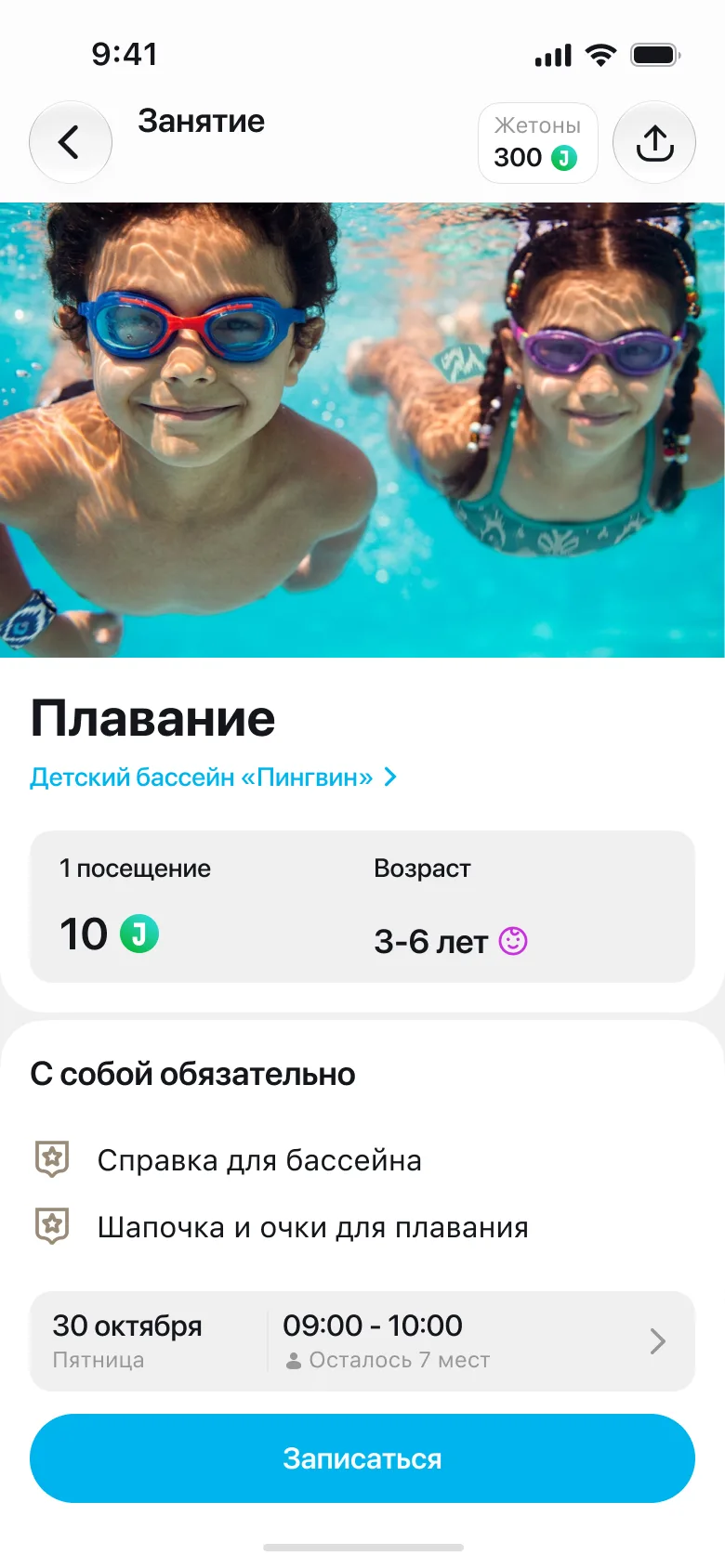
Can swimming be combined with a children’s fitness subscription? Yes, a subscription can make it easier to try different activities and choose a suitable format, but decide on the workload according to your child’s age, well-being, and the instructor’s recommendations.[2] [3]
Sources
- Updated systematic review of swimming instruction and water safety in children · Peer-reviewed scientific review
- How children aged 5–12 learn to swim: a review of motor-learning methods · Peer-reviewed scientific review
- Swimming lessons for children: when to start and what to consider · American Academy of Pediatrics
- The association between swimming lessons and childhood drowning risk: a case-control study · Peer-reviewed scientific study
- Guidance on good posture in children · Pediatric physiotherapy service
- School backpack safety and preventing back pain · American Academy of Pediatrics
- Systematic review of swimming instruction and water-safety programs · World Health Organization